



Find out which SEO tasks provide real results and which ones you can skip or handle on your own. This guide on affordable SEO services for small businesses will help clarify your choices.
When you’re the one signing off on every dollar of marketing spend, promises of SEO effectiveness are not enough. You need proof that it’s going to pay off. But investing in SEO means steady organic growth of your business’s online presence. When done right, SEO can deliver massive long-term results — up to 400% ROI within two years.
Let that sink in: To see SEO results, it’s not necessarily to have deep pockets, a big marketing department, or a retainer they can throw at a fancy agency.
So you need to find the solution to the word problem:
Given: Limited time and budget.
Determine: What’s worth investing in and what can be done in-house.
Not all SEO tasks are equally important, and not every service is worth paying for. The challenge is figuring out which steps deliver real results and which ones you can skip or handle yourself. This guide about affordable SEO services for small business will help you cut through the confusion.
Table of Contents
Why SEO Strategy Is One of the Smartest Investments for Small Businesses
The SEO Services That Actually Move the Needle (And What They Cost)
The Nexus of Search and AI: AEO, GEO, AIO, and SXO
A DIY SEO for Small Business Owners: What You Can Do Yourself to Improve SEO Rankings
What to Look for When Choosing Affordable SEO Services for a Small Business
What to Do First: A 90-Day SEO Plan for Small Budgets
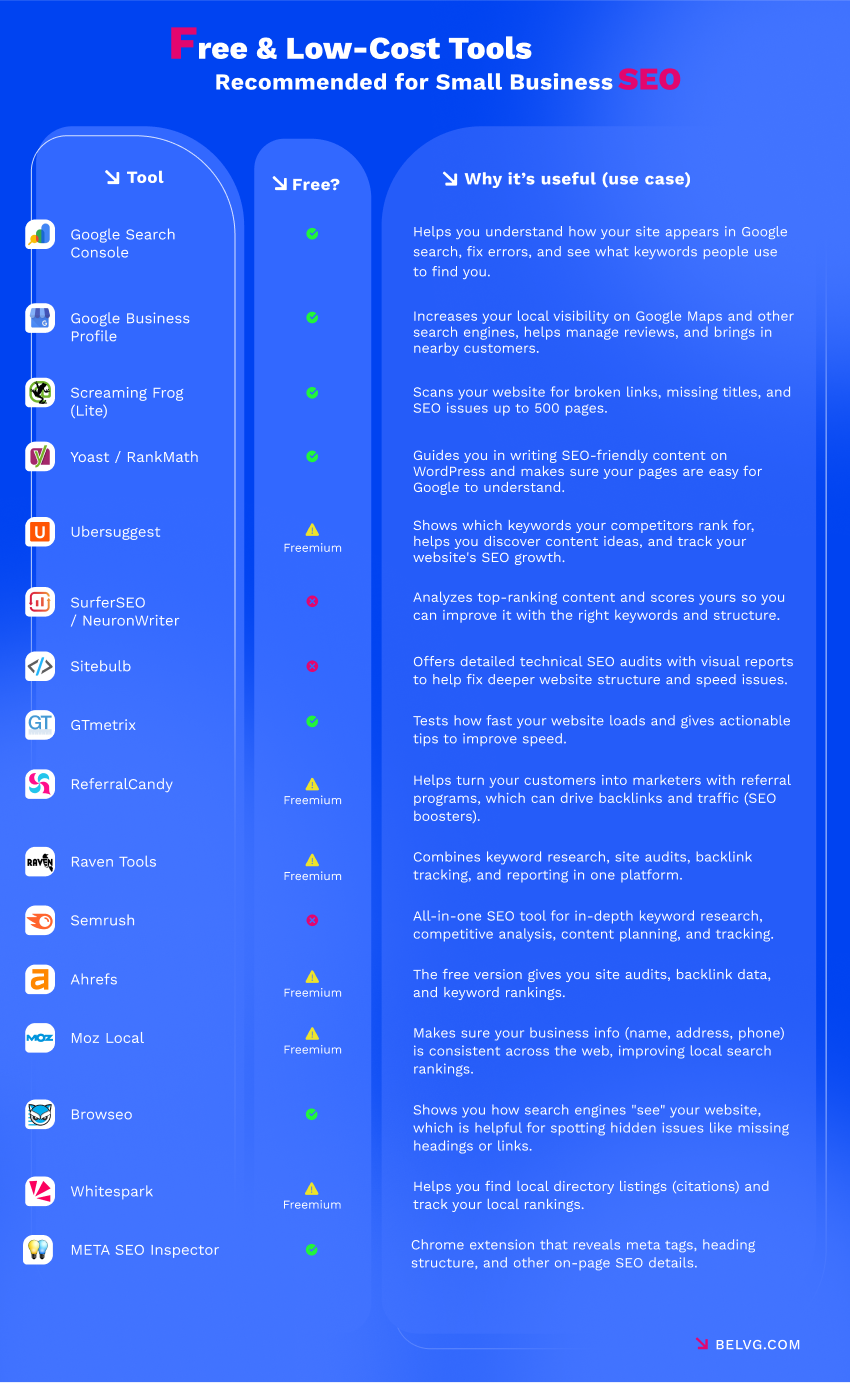
Recommended Free & Low-Cost Tools for Small Business SEO
Why SEO Strategy Is One of the Smartest Investments for Small Businesses
If you’re wondering whether small business SEO is worth it, let’s flip the perspective for a second and think like your customers.
When someone needs a product or service today, where do they go? Google. In fact, 87% of shoppers start their buying journey online, even if they eventually purchase offline. That first touchpoint is often a search engine, not your storefront or social media page.
It means that if you want users to know about you and be your customers, high positions in search engines are a must. If people find you and can get information about your brand and reviews, there is a high chance that you will see an increase in conversion rates. Remember that over 50% of users discover a new brand or product after a search. Here are some more stats:
Here’s what the data shows:
- 49% of customers view up to 5 pieces of content created by a company before ordering a product or talking to a salesperson.
- Up to 80% of people ignore paid search results, clicking on organic search results.
- Over 75% of online users never go further than the first page.
- 95% of consumers trust online reviews.
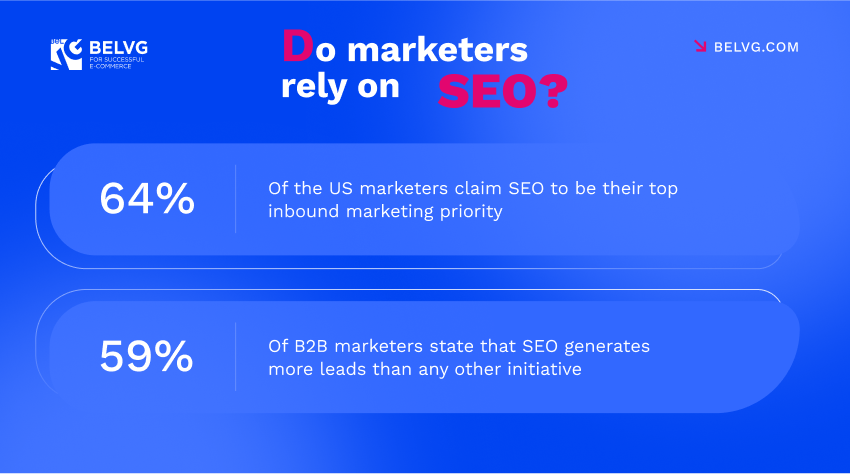
With 92% of online experience starting with a search engine, a perfect SEO strategy has never been more important in winning the ecommerce business competition. You’ve seen the statistics and already understand that SEO is a power. But what exactly can it give to your small business?
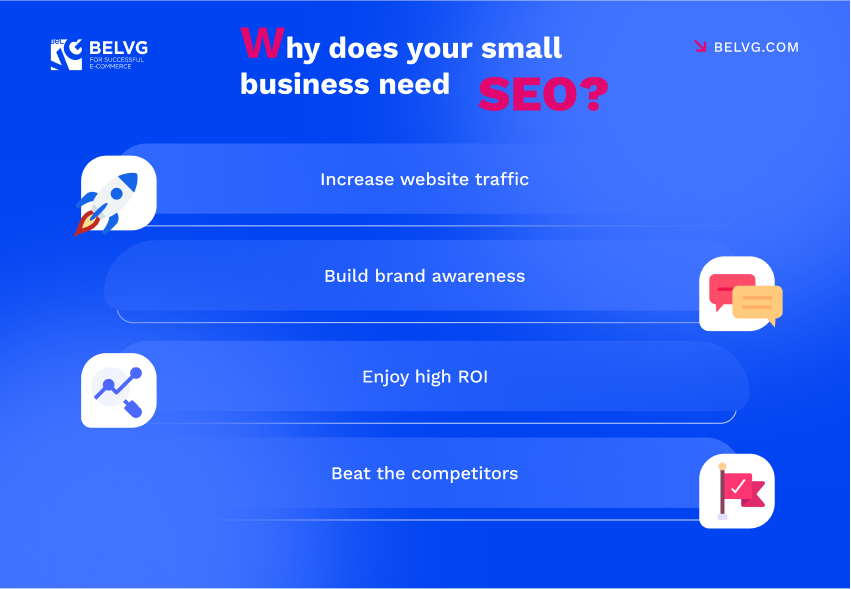
Increase website traffic
This is one of the main reasons for investing in SEO for small business since the better your website, the more customers you have. Statistically, businesses with SEO optimized sites have twice more customers than those without. As a result, they grow twice as fast.
But it’s not just about the sale. Smart SEO dominates the entire customer journey. Your potential buyers are already out there, Googling their problems and researching solutions long before they are ready to pull out their wallet. By optimizing your site to provide clear, immediate answers to all of their questions, you ensure your company is the source they rely on. This consistent “topic coverage” builds undeniable authority and trust. When they are ready to buy, your business is the one they’ll remember.
However, search engine optimization is also a customer experience improvement. SEO tools and strategies allow the creation of well-structured websites that make users desire to stay on the site longer. High loading speed, mobile-friendly, relevant content, structured data location on the website, social networks, and others keep your users satisfied with the website. And if your users are happy to be your customers, you have more chances to rank high in search engine results since the main purpose of search engines is to provide high-quality information to their users.
Build brand awareness and visibility in local search
Among the benefits of getting a higher ranking is building your brand awareness. When your site appears on the first page in Google, Yahoo, and Bing, as well as in ChatGPT and Gemini references, you seem more reliable. Customers are more likely to trust the brand that appears on the first page than those which are not. That is why brand awareness is a must for small businesses, and they need to spend time and money on SEO.
Enjoy high ROI
No matter how much money you invest in marketing, you want to see a return on investment. SEO, unlike other strategies, results over time and needs continuous investments. But if you commit to it, it delivers results that last for years with minimal additional costs. But, as was mentioned before, by doing everything right, you can make a lot like this. Statistically, organic traffic captures over 45% of revenue. Depending on your sphere and products, the percentage might vary.
“SEO has always been a long game, and that hasn’t changed in 2026, but the days of content-for-content’s-sake are over. With Google’s AI Overviews cutting to the chase, real growth now comes from being the irreplaceable expert. That means publishing first-hand content that actually earns citations, locking down your technical foundation, and building quality links that aren’t cheap spam. Focus ruthlessly on the people-first value and measurable ROI—that’s your only armor against the next update.“
— Dziyana Kastahladava, BelVG’s Head of SEO
Beat the competitors
Imagine two local businesses that are providing similar services in the same industry and have similar prices and locations. One company has an SEO-friendly website, while the other does not. Which company will be more profitable? The one with the optimized website will have more customers from local searches and is likely to grow faster than the competitor. As a result, the second company will lose the competition and might go bankrupt.
Local SEO is an effective marketing tool. If your competitors are doing so, ask yourself why you don’t invest money in it, too.
What Does “Affordable SEO Services” Actually Mean?
Affordable Search Engine Optimization isn’t about finding the cheapest provider. These criteria measure affordability:
- Maximizing ROI for every dollar you spend
- Investing in tasks that directly impact visibility, rankings, or conversions
- Avoiding low-quality “bulk” services that do more harm than good
What counts as affordable?
Affordable SEO services are evaluated in terms of value per task, not just monthly cost.
| Budget Range | What You Can Expect |
| $250–$500/month | DIY with strategic help: audits, local SEO setup, content briefs |
| $500–$1,000/month | A mix of DIY and outsourcing: regular content, light technical fixes |
| $1,000–$1,500/month | Full lite campaign: strategy, content, optimizations, monthly reporting |
The SEO Services That Actually Move the Needle (And What They Cost)
Let’s break down services that small businesses should consider, ranked by ROI potential:
1. SEO audit
SEO audit services give you a clear picture of your website’s health: what’s working, what’s broken, and what to prioritize. If you don’t want to waste your budget guessing, it’s better to start with a proper audit.
What it includes:
- Robots.txt & sitemap validation
- Canonical, hreflang, and redirect checks
- Page indexing issues (meta tags, filters, paginated pages)
- Core Web Vitals & TTFB
- Meta tags, headings, and thin content
- Schema markup gaps
- Click depth, broken links, crawl budget usage
Cost: $200–$600 (one-time)
Why it matters:
It helps understand what’s holding your site back and lays the foundation for any smart strategy.
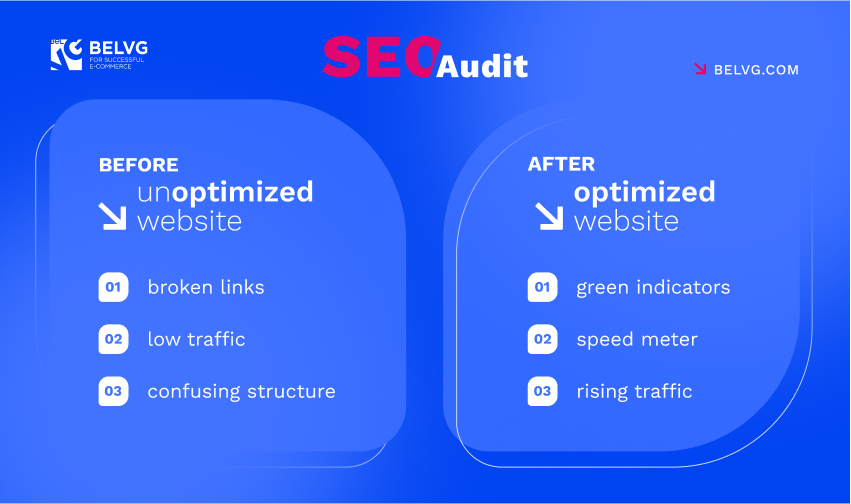
Before vs. After SEO Audit
2. Local SEO Optimization
If your customers find you through Google Maps or search for services “near me,” local SEO can put you on their radar.
What it includes:
- Google Business Profile optimization
- Consistent NAP (name, address, phone)
- Local keywords and content
- Review & citation strategy
Cost: $150–$500
Why it matters:
For service businesses and local stores, it’s a high-ROI move and often one of the fastest ways to increase search visibility and traffic.
3. High-quality content writing & on-page SEO
New blog posts, improved service pages, or optimizing what you already have — content is your long-term traffic engine. When it’s built around strategic keywords, it attracts new visitors and also helps convert them.
What it includes:
- Refresh outdated blog posts
- Add comparison tables, FAQs, and structured formatting
- Ensure minimum word counts (300–500+)
- Fix keyword cannibalization
- Add alt attributes, semantic tags
Cost: $100–$250 per post/page
Why it matters:
Great content brings compounding value since Google “loves” fresh, useful, relevant content. Just 1–2 optimized posts per month can drive long-tail traffic.
4. Technical SEO fixes
Technical issues like slow load times, broken links, and crawl errors silently hurt your rankings. Cleaning these up ensures that your website is accessible, fast, and indexable.
What it includes (must-do first):
- Fix 4xx/5xx errors, redirect chains
- Set proper canonical tags & hreflang (if applicable)
- Force HTTPS and resolve mixed content issues
- Robots.txt & sitemap adjustments
- Ensure one version of the site (WWW/non-WWW redirects)
- Enable compression (Gzip/Brotli), use modern formats (WebP, AVIF)
Cost: $300–$800 (per batch of issues)
Tip: Focus first on what Google Search Console flags under “Page Experience” and “Coverage.” Most of these issues can be fixed in batches by a freelance developer or a specialized SEO.
Why it matters:
Search engines can’t rank what they can’t crawl. Technical health affects every other SEO effort.
5. Meta Tags & On-Page SEO
Once the technical base is solid, improve your existing pages to match search intent better.
What it includes:
- Unique meta titles & descriptions (max 60 / 160 chars)
- One H1 per page, proper use of H2s
- Internal linking from blog/product/category pages
- Optimized URLs (short, clean, keyword-focused)
- Breadcrumbs & structured data
Cost: $100–$250 per page
Why it matters:
Clean, optimized on-page content increases both rankings and CTR.
6. Basic link-building strategy and off-page SEO (optional)
Though backlinks are optional, they still matter. Backlinks and other off-page SEO tools are a strong ranking factor, but only quality links from trusted sites count.
What it includes:
- Local business directories
- Guest posting on niche sites
- Link reclamation
- Ahrefs/SEMrush monitoring for lost/gained links
Cost: $100–$300/month (entry-level)
Why it matters:
Thoughtful, entry-level link building (like online directories or guest posts) can gradually increase your site’s credibility without triggering penalties.
7. Schema markup (optional but effective)
Schema markup helps search engines understand your content better and can lead to rich results like stars, FAQs, product availability, and more in search.
What it includes:
- Product, FAQ, Breadcrumb, Review, LocalBusiness markup, and “Article” markup
- Validation via Google’s Rich Results Test or validator.schema.org
- Either manual JSON-LD or plugin-based setup (e.g., RankMath)
Cost: Often included in content or technical SEO packages; standalone setup $100–$400
Why it matters:
It enhances how your web pages appear in search engine results, improves CTR (click-through rate), and strengthens your SEO signals without needing more content.
Summary: What’s Affordable and High-Impact?

The Nexus of Search and AI: AEO, GEO, AIO, and SXO
Today, the old rules of SEO performance, where success was conducting keyword research, ranking #1, and getting a click, are obsolete. We operate in an AI-first digital marketing, driven by robust generative solutions (such as Google’s AI Overviews) that provide answers directly, often without the user ever leaving the search page.
To stand out now, you need a strategy built for this AI-first world. It relies on four key pillars:
- Answer Engine Optimization (AEO) to secure the top, instant answer.
- Generative Engine Optimization (GEO) to earn the AI’s trust to be cited as the expert source.
- AI Optimization (AIO) uses automation to make complex technical SEO scalable and affordable.
- Search Experience Optimization (SXO) to ensure visibility translates directly into leads and sales.
Pillar 1: Answer Engine Optimization (AEO) Strategy: Write for Answers
When someone asks a question, Google is trying to find the single, perfect, concise answer, which it then puts into the Featured Snippet (Position 0) or reads aloud via voice search (like Siri or Alexa). This means optimizing content to be instantly consumable by algorithms. If you own that answer, you own the traffic.
Advanced Content Formatting (The BLUF Protocol)
The Bottom-Line-Up-Front (BLUF) approach is the AEO gold standard. This is the difference between writing an essay and writing an expert summary.
- Content Mandate: Immediately follow any question-based heading (e.g., <h2>What is Affordable SEO?</h2>) with a direct, 40-60 word answer. This answer must be a self-contained, definitive summary.
- Example: If your heading is “What are the best dog treats for sensitive stomachs?”, the very next sentence should be a direct, definitive answer, perhaps followed by a list of ingredients to avoid.
- Affordable SEO Action: Review your top 10 most valuable content pieces. Convert your current introductory paragraphs into concise, single-paragraph BLUF answers.
- Structure for Extraction: Search engines prefer to extract content from structured elements. Use basic structure to help it extract info:
- Numbered or Bulleted Lists: Excellent for extracting List Snippets (e.g., “5 Steps to an SEO Audit”).
- Tables: Work for Table Snippets (e.g., comparing features or pricing).
- Technical Detail: Ensure the entire answer box content is present in one contiguous block of HTML.
Technical AEO: Maximizing Rich Results
Technical AEO ensures your SEO optimized content is not just readable, but instantly understood as a structured Q&A resource.
- FAQPage Schema: This is the most crucial AEO technical element. Deploying it on your highest-value pages (services, contact, key articles) explicitly tells Google where the questions and answers are.
- Affordable SEO Action: Use a WordPress plugin (like RankMath or Yoast) or leverage Google Tag Manager (GTM) to inject valid JSON-LD for your FAQ content without needing a developer for every page.
Pillar 2: Generative Engine Optimization (GEO) Strategy: Structure for Citations
A significant number of online searches start with Google’s AI Overviews. GEO ensures that when the AI synthesizes an answer, your website is chosen as the trusted source and cited at the bottom. Getting cited is the ultimate signal of authority, and it requires optimizing for machine confidence and authority.
Establishing Citation-Worthiness (E-E-A-T)
Since AI synthesizes, it requires strong confidence signals to cite a source. This links directly to Google’s quality guidelines (E-E-A-T: Experience, Expertise, Authority, Trust).
- Content Depth and Coverage: Move beyond single articles to create topic clusters. By interlinking specialized content (e.g., a hub page on “Local SEO” linking to spoke pages on “NAP Consistency” and “Review Strategy”), you signal comprehensive Expertise to the LLM.
- Internal Authority Signals: Always link the content back to an author (with a dedicated author page) and ensure the page clearly displays the DatePublished and DateModified (an AIO task). This builds Trust.
- External Authority Signals: The core of GEO is demonstrating Authority. You must naturally accrue backlinks from credible, relevant sources.
- Affordable SEO Action: Focus your link-building strategy on quality over quantity. Instead of buying cheap, generic links on third-party sites, focus on getting cited by local directories (like your Chamber of Commerce) or relevant industry associations. This type of targeted, high-confidence link delivers massive GEO value.
Advanced Structured Data (The Confidence Score)
Structured data increases the AI’s “confidence score” in your content by eradicating ambiguity.
- LocalBusiness and Organization Schema: Absolutely critical for local GEO. This schema links your online presence to a verifiable physical entity.
- Technical Detail: Ensure the schema includes your exact Geo-coordinates (latitude and longitude). This small detail is highly authoritative for local AI queries.
- Article Schema for LLMs: This provides essential metadata (Headline, Author, DatePublished, Image) that the AI uses to correctly attribute and synthesize the information. It is necessary for news or evergreen editorial content.
- Key GEO Measurement: You must track Inclusion Rate in AI Overviews and Referral Traffic explicitly from AI platforms, moving beyond standard organic traffic reports.
- Affordable SEO Action: For local businesses, ensure your schema includes your precise latitude and longitude, a small, highly authoritative detail that boosts AI confidence in your location.
Pillar 3: AI Optimization (AIO) Strategy: Automation to Scale Without Adding Staff
The fear that SEO requires massive investment is often rooted in the amount of repetitive, technical grunt work it used to require. AIO is the solution. It’s about leveraging affordable AI tools to handle the monotonous tasks, allowing your small team (or even just you) to focus on strategy and creativity.
The Technical Co-Pilot: Leveraging Affordable AI
AIO doesn’t require replacing the human strategist; it’s about replacing repetitive, error-prone tasks.
- Automating Technical Governance:
- Continuous Audits: Use affordable tools like Screaming Frog (free for 500 URLs) or Sitebulb to set up automated weekly crawls.
- Predictive Issue Flagging: AI models can flag potential issues (e.g., sudden drop in crawl rate, unusual bot activity) before they turn into major penalties.
- Scaling Content & Structure:
- Schema Generation: Instead of manually writing JSON-LD, use AI automation features in CMS plugins or low-code tools like n8n to bulk-deploy schema types (FAQ, Product) across similar pages.
- Content Refresh Workflows: AIO tools can analyze content decay signals (like low CTR or declining rankings) and automatically generate an optimization brief for a human editor, identifying new keywords and data points to ensure AEO freshness.
- Affordable SEO Action: Start by using Google Search Console’s API, paired with a simple spreadsheet to automatically flag pages with low impressions or high crawl errors.
Pillar 4: Search Experience Optimization (SXO) Strategy: Optimize the Reader Journey
SXO is the final, important step that validates your entire XEO investment. It ensures that the hard-won visibility from AEO and GEO translates into conversions and business outcomes.
Core UX Elements: Fulfilling the Promise
The user experience must align with the intent of the search query.
- Intent Fulfillment: If a potential customer searched for “Affordable Commercial Cleaning Price List,” your landing page cannot be a 500-word essay on your mission statement. It must immediately have a clear, transparent price breakdown or a button leading directly to it. Any mismatch will result in a high Search Exit Rate.
- Friction Reduction (Time to Find): Optimize for speed and transparency. Every extra second of load time and every unnecessary click is friction.
- Technical Detail: Prioritize optimizing images (WebP/AVIF formats), minifying CSS/JavaScript, and ensuring mobile-friendliness (a local GEO and SXO requirement).
- Affordable SEO Action: Use the free insights from GTmetrix and Google PageSpeed Insights to identify and fix Core Web Vitals issues in batches.
- Clear Calls-to-Action (CTAs): A high-authority page (cited by AI) must have a clear next step. The CTA should facilitate the user’s task completion (e.g., “Get an Audit,” “Request Quote,” “View Pricing”).
Measuring Business Impact Beyond Traffic
SXO forces a shift in measurement from traffic to revenue.
- Search Exit Rate (Primary Metric): A high rate is a sign that your content failed to satisfy the user’s need after the click.
- Diagnosis: Use Google Analytics (GA4) to identify pages with a high exit rate from search traffic. If the exit rate is high, the content requires a UX/intent review.
- Conversions from Search (Profitability Metric): Track not just SEO traffic but the conversion events that originate from search sessions, including Average Order Value (AOV) for those sessions. This directly proves the ROI of your XEO strategy.
- Strategic Goal: SXO assures that the technical optimization you performed (AEO/GEO) is functionally delivering high-quality, high-intent leads that are easy to convert.
A DIY SEO for Small Business Owners: What You Can Do Yourself to Improve SEO Rankings
Even without hiring anyone, you can make SEO progress in-house. Here’s a prioritized checklist:
Set up your Google Business profile and Google Analytics
- Complete all sections (hours, description, services)
- Add images and collect reviews
- Update regularly
Optimize page titles and meta descriptions
- Use target keywords naturally
- Keep title tags under 60 characters and metas under 160
Win the Instant Answer (AEO Action)
- Implement the BLUF Rule for your top 5 highest-value pages
- Use Lists and Tables
Update content for relevance
- Add internal links
- Include updated stats or insights
- Improve readability and structure
- Add the author’s name and the publication date to every blog post or article
Fix basic site issues
- Check for 404 errors
- Redirect broken links
- Optimize images for size and alt tags
- Use Google PageSpeed Insights to check your top 3 pages, and fix the one highest-impact item
Submit your site to Google Search Console
- Upload your XML sitemap
- Monitor indexing and errors
- Track performance with built-in reports
- What to Outsource (And What to Keep In-House)
- Use the “Pages” or “Performance” report to quickly find pages with a high number of Crawl Errors or Low Impressions
- Focus your content updates on these pages for the quickest ROI
Knowing what not to do yourself saves time and protects your site from costly mistakes.
| Task | Do It Yourself? | Why/Why Not |
| Google Business Profile | ✅ Yes | Simple interface, big impact |
| On-page content editing | ✅ Yes | Can follow templates and guides |
| SEO audits | ❌ Maybe | Requires tools, knowledge, and benchmarking |
| Technical fixes (speed, hreflang) | ❌ No | Needs dev access and precision |
| Backlink outreach | ❌ Maybe | Time-consuming and sensitive if done wrong |
| Schema markup | ❌ Maybe | Safe with plugins, but custom cases need dev help |
What to Look for When Choosing Affordable SEO Services for a Small Business
When hiring an SEO company on a small budget, you’re trying to balance cost with quality without getting burned by empty promises or generic reports. Here’s how to find an SEO service provider who can deliver real results without charging enterprise-level fees.
Clear deliverables (not vague promises)
A trustworthy SEO company will tell you exactly what you’re getting each month, not just “cost-effective SEO services.”
Look for:
- Monthly content deliverables (e.g., 2 blog posts, 5 on-page optimizations)
- Technical fixes are listed clearly
- Reporting schedule and KPIs
Red flag: “We’ll do everything you need for $99/month.” If they can’t define “everything,” they won’t deliver anything meaningful.
Realistic expectations, no “guaranteed rankings”
SEO takes time, especially if your website is new or your niche is competitive. No one can ethically guarantee rankings on Google, not even Google employees.
Look for:
- Honest timelines (3–6 months for measurable improvements)
- Focus on traffic quality and conversions, not just keyword positions
- Education and strategy, not just tasks
Red flag: “Page 1 in 30 days guaranteed.” That’s not how SEO works.
Focus on your business goals, not just relevant keywords
Affordable doesn’t mean cookie-cutter. Even on a budget, the agency should try to understand your business model and align your SEO strategy accordingly.
Look for:
- Niche-specific recommendations
- Pages prioritized by value (not random keyword targeting)
- Interest in your products, customer personas, or competitors
Red flag: Pre-packaged keyword lists that don’t match your services.
Transparency with tools and tactics
You should never wonder what’s being done behind the scenes. A good agency explains their approach, including what tools they use and how they measure SEO success.
Look for:
- Shared dashboards or monthly reports
- Access to tools or logins (like Google Analytics, Google Search Console, etc.)
- Willingness to explain strategies in plain language
Red flag: “We can’t show you our methods because it’s proprietary.” That’s often code for spammy tactics.
Lean but skilled teams or solo SEO specialists
You don’t need a large agency. Often, a specialized consultant or small team can deliver better results at a lower cost.
Look for:
- Niche freelancers or SEO small businesses with proven case studies
- Direct communication with the person doing the work
- Focused service packages, not bloated retainers
Red flag: Massive firms offering “affordable” SEO but outsourcing everything to junior staff or overseas teams with no oversight.
Adaptable services that grow with your business
The right SEO partner helps you prioritize now and scale later. They should offer modular services like audits, one-off fixes, or content packages that align with your current budget.
Look for:
- A la carte pricing or flexible plans
- Ability to pause or switch focus (e.g., from technical to SEO content)
- Willingness to explain which services to postpone until you’re ready
Red flag: Locked-in 12-month contracts with no flexibility or transparency in SEO tasks.
Questions to Ask During a Discovery Call
A good SEO company won’t sell you magic. Instead, they’ll work with your budget to identify the highest-impact actions and provide SEO tips to build a sustainable path to growth. Ask these to quickly spot a good fit:
- “What would you focus on first for a business like mine?”
- “What does your monthly report include?”
- “Can I see an example of an audit or deliverable?”
- “How do you define success for your clients?”
Avoid these common SEO money traps
Cheap small-business SEO often equals low-quality SEO. Here’s what to avoid:
- “Guaranteed rankings”
- Bulk backlinks from shady sites
- Keyword stuffing
- Content spinning or AI-generated filler
- Agencies that don’t explain what they’re doing
- Monthly fees with no clear deliverables
Instead, look for transparency, case studies, and providers who talk about ROI, not just rankings.
What to Do First: A 90-Day SEO Plan for Small Budgets
The wise prioritization also impacts how much affordable SEO will be. Here’s the month-to-month plan for how you can start:
Month 1: Audit and fix
- Run a site audit (or outsource one)
- Fix critical technical errors
- Set up GSC and Google Business
- Optimize the homepage and the top 3 product pages that are more likely to convert
Month 2: Optimize and expand
- Refresh old SEO content
- Publish 1–2 new blog posts
- Get listed in local directories
- Collect 5+ Google reviews
Month 3: Build and monitor
- Add an internal linking structure
- Begin backlink outreach
- Implement structured data (schema markup) for key pages
- Monitor rankings and CTR
- Plan a content calendar for the next 90 days
Budget planning: what you can expect for the money
| Budget Level | Breakdown | Expected Results (3–6 months) |
| $250/month | DIY + audit or local SEO setup | Foundational improvements, minor traffic gains |
| $500/month | Audit + part-time help with SEO content or fixes | Growing rankings, better UX |
| $1,000/month + budget on backlinks | Strategy + consistent content + light link building | Measurable search traffic + lead growth |
| $1,500+/month + budget on backlinks | Full SEO campaign with reporting and tracking | Long-term organic growth + online visibility |
Recommended Free & Low-Cost Tools for Small Business SEO
Case Spotlight #1: How Ekstralys Migrated Without Losing SEO and Gained Performance
Ekstralys, a Scandinavian leader in automotive lighting, was running six stores across four countries. Some of them were B2B, some B2C but all on an aging Magento 1 setup. Their SEO performance was flatlining, page speed was dragging, and Magento 1 had officially reached its support.
That’s when they called us in.
We started with the basics: patching security holes, optimizing meta tags, fixing broken navigation, and compressing images. But Ekstralys was thinking bigger and wanted a full migration to Adobe Commerce Cloud without sacrificing SEO.
So we got to work.
We migrated over 100+ WordPress blog pages into Magento 2 using Page Builder, preserving valuable content and backlinks. We mapped old URLs to new ones and retained product and category SEO data to protect their search rankings.
Next came the technical upgrade. We restructured schema.org markup to meet SEO standards and significantly improved page speed. Thanks to that, we managed to hit 90+ on Google PageSpeed for desktop and an A-rating on GTmetrix.
Also, we added smart features like dynamic SEO URLs for configurable products, making long-tail keywords indexable and shareable. We even integrated Klevu AI search with SEO-friendly enhancements like price visibility by region and the inclusion of WordPress articles in search results.
As a result, Ekstralys has a faster, smarter, SEO-ready ecommerce engine without losing its hard-earned visibility during the migration.
Website Audit
Learn how BelVG's free audit of your online store helps find the growth points.
Learn MoreCase Spotlight #2: Caskers Migrated Without Losing Search Engine Ranking and Came Back Stronger
Caskers is a premium New York brand for rare and limited-edition spirits. Their Magento 1 site was nearing end-of-life, but with over 400,000 customers and 250,000+ pages, a risky migration could tank their SEO rankings and cost them their hard-earned traffic.
They came to us with one clear ask: “Migrate us to Magento 2 Open Source without breaking our SEO.”
BelVG preserved its structure, migrated all product and category SEO data, and kept URL rewrites in place to protect rankings. Everything made it to the new platform intact.
To avoid performance drops (and SEO penalties), we ran a full audit and optimized content and image sizes. The new theme we designed stayed true to their brand but improved load times and mobile usability which are key ranking factors.
We also built dynamic product preview URLs and improved metadata across thousands of pages, supporting their advanced SEO strategy while giving Google’s crawlers exactly what they needed.
Eventually, Caskers kept their SEO authority, sped up performance, and launched a modern, scalable site — all before the holiday marketing season.
Final Thoughts: SEO is Your Silent Sales Engine
When you own a small business, every click counts, and every lead matters. SEO helps with ranking higher on Google search results, but the main goal is to make your business found by the right people at the right time, with the right message. Whatever your goal — to attract local customers, grow your online store, or simply stand out in a crowded market — search engine optimization can help you achieve it more efficiently and affordably.
You don’t need a massive budget to get organic search results. You just need a smart strategy, the right priorities, and a team that knows what they’re doing.
Reach out for a free consultation or request a custom SEO audit to make it work for you.
i am very happy to see you content,This one content is very use full for me.
Thanks for Sharing very informative and valuable information.
I read your blog and gain knowledge about SEO technique. Thanks for Sharing very informative and valuable information.
All these tools are useful for best seo.
browseo is something new to me thank you for the information
It’s actually a great and useful piece of info. I’m happy that you just shared this useful info with us. Please stay us informed like this. Thank you for sharing.
Nice article and very informative on SEO services for small business.
Amazing blog post!!
You have shared valuable information about seo services. Keep it up!!
SEO can show your website to the consumer who’s looking for your service in search engines and tell about how much importance of сost of SEO For Small Business. All these above-mentioned benefits are just awesome for any business. Keep sharing such knowledgeable articles.