



If you are searching for the appropriate type of shipping for your ecommerce business, you are on the right way. The competition in the market is severe today. Since the COVID-19 pandemic, global online ecommerce sales have increased from 3.354 billion USD in 2019 to 6.04 billion USD in 2024, and the forecast predicts it to grow.
However, ecommerce businesses need help in choosing efficient strategies for attracting shoppers.
According to statistics, one of the most frequent reasons why customers leave online shopping carts is poorly organized shipping process. Customers may pay extra fees, experience slow delivery times, inappropriate tracking methods, and more.
A badly structured shipping process and high shipping costs may carry a fee of potential customer loss, while a suitable shipping method will help you avoid possible issues and improve your income.
You will learn about the most widely-used shipping methods for your ecommerce business according to time of delivery, types and rates, and top shipping carriers in 2026 from this article.
Table of Contents:
15 types of ecommerce shipping methods in 2026
Top 3 US ecommerce delivery companies in 2026
9 factors to consider when choosing shipping services
BelVG’s Experience in Implementing Shipping Into Ecommerce
Conclusion
15 Types of Ecommerce Shipping Methods in 2026
According to Statista, 17% of all retail purchases will be made via ecommerce than in brick-and-mortar channels. This year, this percentage and customer expectations have grown more. So, to succeed, you need to find a balance between affordable options for your company, your customers’ needs, and possibilities for your logistics.
A good shipping strategy for your business is a solution, as the role of ecommerce delivery is vital. Before choosing the appropriate delivery model, it is better to analyze different shipping methods first.
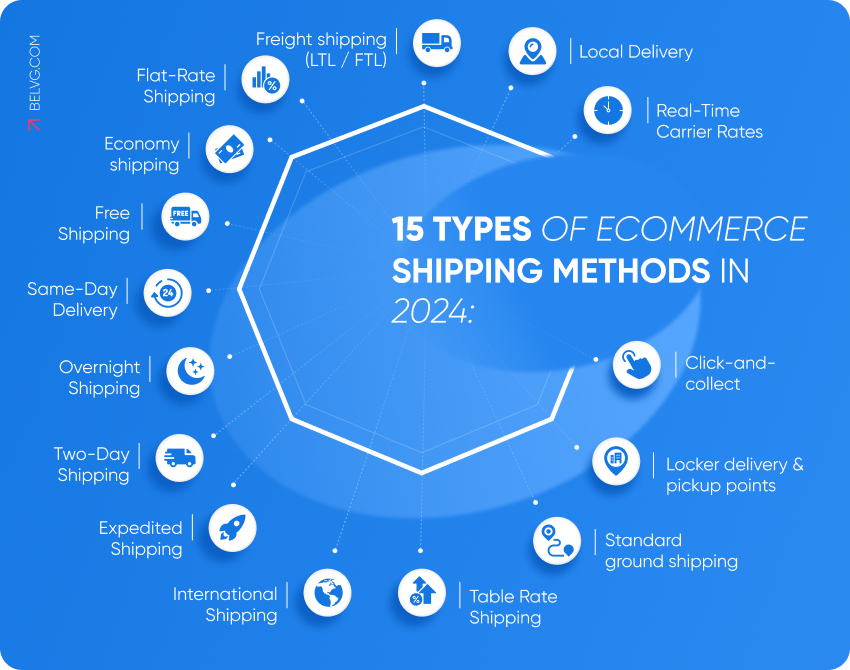
Let’s have a look at all the types of shipping that were used in 2024.
Free Shipping
Free shipping is still widely used in online shopping and is attractive to customers. If you offer free shipping, doesn’t mean you don’t pay for it. This shipping method also has expenses that need to be covered. It is possible to include them in the product rates and increase the prices. But this decision decreases your competitiveness.
Still, there are several solutions to offer free shipping successfully for businesses:
- Use it as a promotional tool to increase sales
- Make accents on upsells and cross-sells
- Suggest this shipping method exclusively to loyalty club members
- Offer free shipping as an option for slower delivery
When to use: for boosting conversions, clearing inventory, or rewarding loyal customers.
Benefit: Increases conversion rates and reduces cart abandonment.
Same-Day Delivery
This ecommerce delivery method guarantees that the customers receive their purchase on the same day they pay for it.
Same-day delivery is possible if your company owns a local inventory in the same city, has a streamlined courier service, and has a partnership with delivery services that can offer quick order processing and shipping.
When to use: for local delivery and time-sensitive products.
Benefit: Increases customer satisfaction and adds to competitiveness in urban markets.
Overnight Shipping
This shipping method means that the customer receives the order on the next business day, and most customers pay an extra shipping fee for the urgency. It’s an exceptional option for delivering parcels critical to receiving as soon as possible: medicines, important documents, and more.
When to use: for high-value, perishable, or urgent deliveries.
Benefit: Provides premium service for time-sensitive orders.
Two-Day Shipping
This type of shipping is one of the best ecommerce shipping solutions. 90% of customers expect to receive their purchases normally in 2-3 days after ordering. 2-day shipping is a practical solution to reduce cart abandonment, increase conversion rates, and improve customer experience. It gives a competitive advantage to the company that provides it. And it’s also convenient, as it’s not necessary to have a warehouse in every locality, but in every region.
When to use: for a standard ecommerce business looking to balance speed and cost.
Benefit: Contributes to customer trust and repeat purchases.
Expedited Shipping
It’s one of the fastest ecommerce shipping models, offering priority delivery of high-demand purchases. It includes all shipping types with durations less than three business days or those that take less time than usual deliveries.
When to use: when customers are willing to pay more for speed, but overnight is not required.
Benefit: Gives shoppers more flexibility and increases perceived value.
Local Delivery
Another convenient shipping method provides delivering the purchase made online by a customer to his doorstep on the same.
It is possible to arrange a local delivery with the help of your couriers or to prepare the order for the customer to pick it up from the store themselves.
Delivering directly to the customers reduces any added shipping costs.
When to use: for businesses operating within a limited shipping zone or offering local services.
Benefit: Reduces added shipping costs and allows for a personalized delivery experience.
International Shipping
It’s a brilliant chance to spread your brand abroad in other countries. This ecommerce shipping delivers goods by air, sea, and road. An essential point here is to find a reliable partner and sharply examine the details of additional taxes, regulations, and costs.
When to use: for global expansion or stores with international customer bases.
Benefit: Increases sales potential and brand reach.
Shipping rates
As for the rates of different ecommerce shipping services, they directly depend on four factors:
- Packing cost
- Labor cost
- Fees by the courier company to deliver the order
- Import/export, government fees, and extra costs
Flat-Rate Shipping
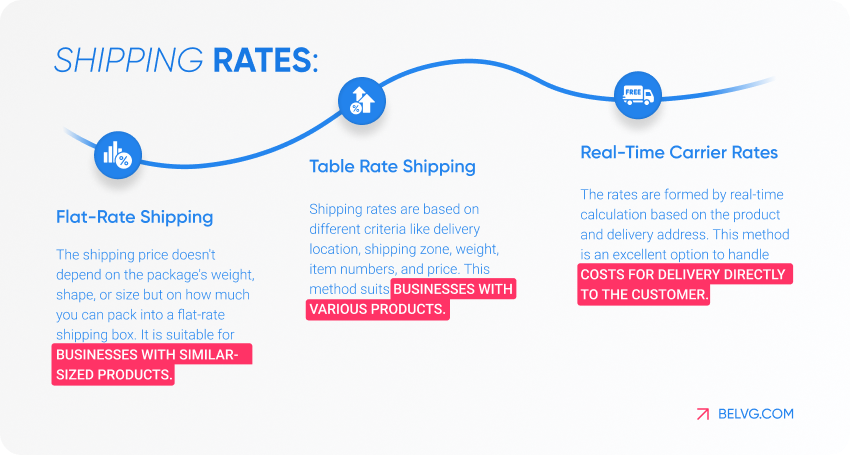
Flat-rate shipping is a popular option in ecommerce. Here, the shipping price doesn’t depend on the weight, shape, or size of the package but on how much you can pack into a flat-rate shipping box. This point makes it suitable for small businesses or those with a standard product line that includes similar products or the same size and weight.
When to use: when product sizes and weights are consistent.
Benefit: Simplifies pricing and improves predictability for both business and customer.
Table Rate Shipping
This type of ecommerce delivery implies shipping rates based on different criteria like delivery location, shipping zone, weight, item numbers, and price. This method is suitable for businesses with a wide variety of products requiring different shipping options.
When to use: for businesses with complex inventory or multiple fulfillment centers.
Benefit: Offers tailored shipping costs while maintaining control over profit margins.
Real-Time Carrier Rates
The rates here are formed by real-time calculation based on the product and delivery address. This method is a good option to handle shipping costs directly to the customer.
The variety of shipping methods is wide. A proper ecommerce shipping strategy helps you to make your business more efficient, stay strong in the competition, and improve your customer satisfaction and loyalty.
When to use: for stores using major shipping carriers and needing up-to-date pricing.
Benefit: Keeps costs transparent and ensures accurate shipping charges.
Freight shipping (LTL / FTL)
If your ecommerce store sells and ships mass quantities or bulk items such as furniture, heavy equipment, gym gear, etc., freight shipping is a must-have. This includes LTL (Less Than Truckload) and FTL (Full Truckload) options depending on order volume. While it’s not necessary for every store, freight shipping is essential for B2B ecommerce and high-ticket D2C products.
When to use: large, oversized, or heavy items that exceed typical parcel dimensions.
Benefit: Lower shipping costs per unit for bulk orders and improved handling for fragile goods.
Economy shipping
Sometimes speed isn’t everything. Economy shipping is a slower but more cost-effective method for customers who are price-sensitive and not in a rush. It’s a popular option for non-urgent goods and budget-friendly checkout experiences.
When to use: low-value or non-urgent items where delivery may take 5–10 days.
Benefit: Helps you serve price-conscious shoppers while preserving margins.
Standard ground shipping
Often considered the “default” option, standard ground shipping covers delivery within 2–7 business days and is handled by major carriers. It’s one of the most stable methods and works well for a majority of ecommerce categories.
When to use: general merchandise and orders that don’t require speed or special handling.
Benefit: Reliable and widely supported by all major shipping providers.
Click-and-collect (in-store pickup)
Not every shopper wants delivery at home. With Click-and-Collect, customers place an order online and then pick it up at a nearby physical location. It’s popular among fashion, grocery, and electronics stores and it can reduce your shipping costs significantly.
When to use: if you have physical stores or partnerships with local pickup points.
Benefit: Fast fulfillment, reduced last-mile delivery costs, and more foot traffic.
Locker delivery & pickup points
Major carriers like Amazon, DHL, and InPost offer locker delivery services where customers pick up their parcels from a secure, self-service locker. This method is especially attractive in urban areas where missed deliveries are common.
When to use: densely populated areas or where failed deliveries are frequent.
Benefit: Fewer failed delivery attempts and more convenience for busy shoppers.
Trends in Ecommerce Shipping in 2026
The world of ecommerce shipping continues to evolve rapidly. New technologies, rising shoppers’ expectations, and global logistics challenges are shaping how online stores ship products to customers. If you want to stay competitive in 20265, it’s not just about choosing a shipping method—it’s about understanding what shoppers expect right now and where the market is headed.
Let’s take a closer look at the key ecommerce shipping trends in 2026.
1. Multi-carrier and hybrid shipping models
More ecommerce businesses are moving away from depending on a single carrier. Instead, they build multi-carrier strategies, combining national services like UPS and FedEx with regional or local couriers for last-mile delivery. This helps cover more ground, reduce shipping costs, and handle unexpected delays more flexibly.
Some stores also use hybrid shipping models, where multiple shipping carriers handle different parts of the delivery journey. For example, a major carrier transports the package to a regional hub, and a local service delivers it to the customer’s door.
Why it matters: Better delivery coverage, lower costs, and improved customer experience.
2. AI-driven delivery optimization
Artificial intelligence is helping ecommerce stores optimize shipping routes, predict delivery times, and manage inventory. AI tools now analyze order patterns and suggest the most efficient way to pack and ship products to customers.
This means faster deliveries, fewer errors, and more personalized experiences, especially for businesses with complex or high-volume shipping needs.
Why it matters: Increases operational efficiency and helps reduce last-mile delivery problems.
3. Sustainability and eco-friendly shipping
Today’s customers care about the environmental impact of their purchases. In response, shipping carriers and ecommerce stores are offering carbon-neutral delivery options, using electric delivery vehicles, and optimizing routes to reduce emissions.
Some ecommerce platforms now include a small optional fee at checkout for carbon offsetting. Others promote eco-friendly packaging or partner with shipping carriers like Sendle that focus on sustainable logistics from the start.
Why it matters: Builds trust with eco-conscious shoppers and supports long-term sustainability goals.
4. Local fulfillment process and micro warehousing
Speed is everything in 2026. That’s why more businesses are using local fulfillment centers and micro-warehouses, smaller storage hubs placed closer to high-order regions. This approach reduces delivery time and costs while offering same-day or next-day delivery without relying on a nationwide infrastructure.
It’s not just for giants like Amazon anymore, but smaller ecommerce brands create fulfillment centers and microwarehousing, too.
Why it matters: Enables faster, cheaper shipping in key markets and improves order predictability.
5. Flexible delivery options at checkout
Today’s customers expect more than just “express” and “standard” shipping. In 2026, ecommerce sites are offering pickup lockers, in-store pickup, delivery scheduling, and even “leave at door” or “hand to neighbor” options — all directly from the checkout page.
These small choices make a big difference in convenience and satisfaction.
Why it matters: Increases conversion rates and reduces failed delivery attempts.
Top 3 US ecommerce delivery companies in 2026
Ecommerce delivery companies’ responsibility starts with moving an order from an online store and ends by delivering it to the customer’s doorstep.
Handling an ecommerce business is hardly possible without the shipping companies. Let’s look at and compare the leaders of e-commerce shipping.
UPS (United Parcel Service)
According to Forbes GLOBAL 2000, UPS is 172nd among the world’s top 2000 companies. The company, which also serves Amazon, made sales of $91.07 billion in 2024, while its biggest competitor, FedEx, made $87.69 billion, which is 212th on the list.
UPS is a multinational shipping services company with 24 million daily packages in 220+ countries.
The company provides services in logistics, package delivery, and supply chain. UPS operates through U.S. Domestic Packages, International Packages, and Supply Chain and Freight.
- The U.S. Domestic Package segment includes all types of ground and air shipping services.
- The International Package segment offers ecommerce shipping models of small packages worldwide.
- The Supply Chain and Freight segment provides transportation, distribution, and International trade and brokerage services.
The Services:
- UPS Ground: The service takes up to five days for delivery.
- UPS 3-day Select: This service is best for less time-sensitive couriers. Depending on demand and weather conditions, it will use either ground or air service. Delivery can take up to three days.
- UPS Next-day Air: This service provides overnight delivery with morning or afternoon arrival.
- UPS Express Critical: This is their fastest service that delivers to all 50 states including DC and Puerto Rico by the end of the day.
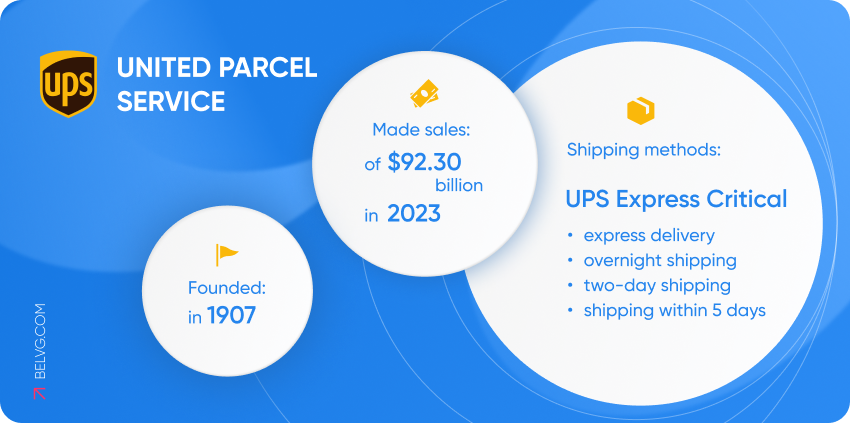
| UPS Overview |
| Company name: | UPS (United Parcel Service) |
| Founded: | 1907 |
| Shipping methods: | UPS Express Critical – express delivery, overnight shipping, two-day shipping, shipping within 5 days |
Key additional services:
-
- Declared value package
It is possible to declare the value of the package and to be secured in case the package is lost or damaged.
-
- UPS Carbon Neutral
Customers who care about the environment can cover the carbon emissions caused by the transportation process of the shipment.
-
- Proof of Delivery (P.O.D.)
The company sends delivery details by email, fax, or mail as an optional method apart from tracking the shipment on UPS.com.
FedEx
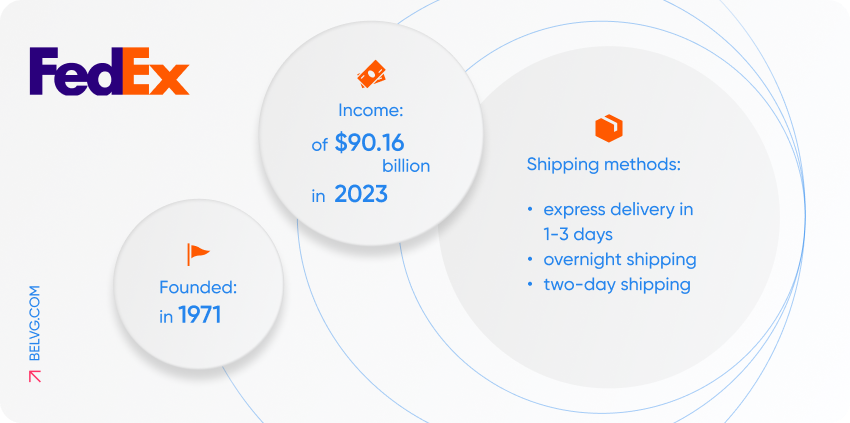
Another world ecommerce delivery company with headquarters in the USA. In 2025, FedEx was the leading North American carrier with a revenue of over $78 billion, while UPS was in second place.
FedEx offers transportation, ecommerce, and business shipping services worldwide.
They include the following segments:
- FedEx Express segment provides domestic and multinational package and freight shipping.
- FedEx Ground segment ships small-package ground deliveries.
- The FedEx Freight segment focuses on less-than-truckload freight services.
The FedEx Services segment provides marketing, sales, technical support, helps with billing and collection services, and more.
The Services
- FedEx International Priority Express includes shipping in 1-3 business days to special destinations in Canada, Asia, Europe, and the United States.
- FedEx International Priority is used for the delivery of important documents or boxes to over 220 countries by the end of the same business day.
- FedEx International First offers express shipping services for documents and boxes in the early morning in special destination countries or territories.
| FedEx Overview |
| Company name: | FedEx |
| Founded: | 1971 |
| Shipping methods: | express delivery in 1-3 days, international shipping, overnight shipping, two-day shipping |
Key additional services:
- Customs made easier offers the resources and tools to find out whether the shipment answers the importing country’s regulations.
- FedEx Delivery Manager means carrying the packages into the recipient’s hands 100%. The manager sends an email or a text message and specifies the time and day of the delivery. The recipient can change the delivery date or even delegate receiving the box to a neighbor.
USPS (United States Postal Service)
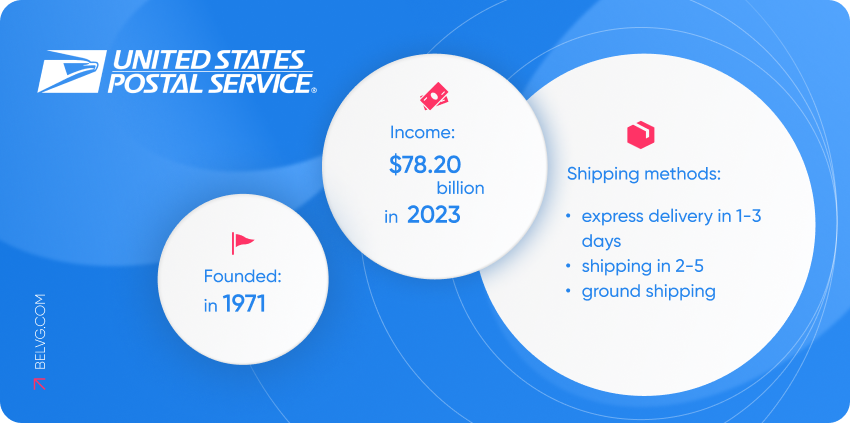
USPS has been the most visited mail and package delivery website in 2024 worldwide, with an average of 292 million visits per month.
It is a US governmental postal service agency. The company offers shipping services not only in the USA but also international shipping all over the world, delivering both mail and packages. The segments of USPS include:
- USPS Connect Local delivery is a local shipping strategy where businesses start partnering with the local Post Office and receive their deliveries at fixed, low prices and on the Same Day and Next Day.
- USPS Connect ecommerce works especially with ecommerce platforms. It offers the opportunity to work with the USPS directly, and the business gets the advantages of obtaining an accelerated agreement process, discounted rates for the platform and sellers, and no minimum volume requirements.
Services:
- Priority Mail Express: fast air delivery for urgent mail, and is available Monday through Friday, excluding weekends and holidays.
- Priority Mail: also a fast air delivery that sends packages within 1-3 days, including free delivery boxes and envelopes.
- First Class Mail: This service sends regular mail within 5 business days, such as postcards and letters in small envelopes.
- USPS Ground Advantage: the service offers to save money by low rates for packages delivered by ground with expected delivery in 2-5 business days.
| USPS Overview |
| Company name: | UPSP |
| Founded: | 1791 |
| Shipping methods: | express delivery in 1-3 days, shipping in 2-5, ground shipping, international shipping |
9 factors to consider when choosing shipping services
The shipping method is the last touchpoint between a customer and your online store in the purchasing process.
So, to minimize the risks of customers’ cart abandonment and to be in high demand, it is crucially important to have reliable ecommerce delivery companies as partners.
Badly organized shipping might hurt your reputation.
The best way to avoid that is to choose the right partner by considering the following factors.
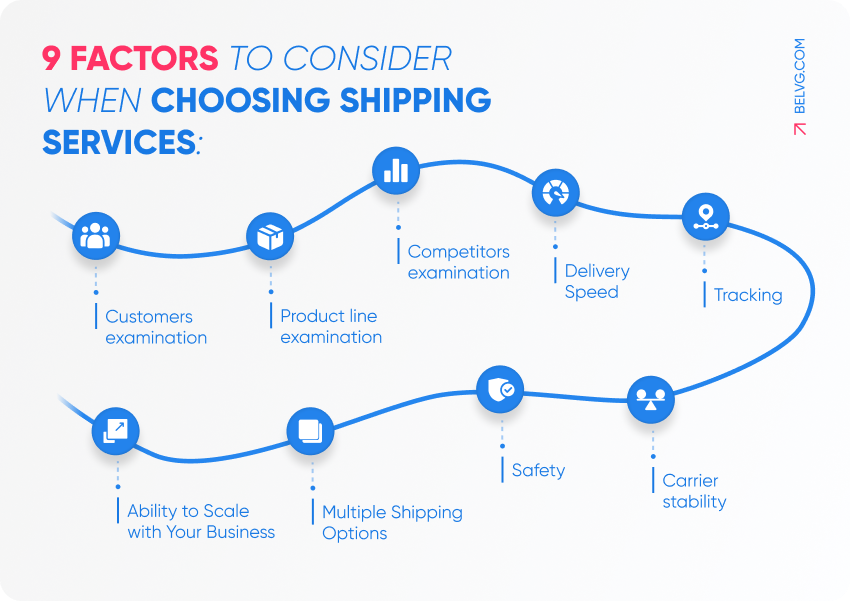
Your customers, product line, and competitors
- The customers
Consider the location of your customers and figure out their expectations in shipping and how long they are ready to wait for the orders.
- The product line
Note the cost, size, and weight of your products, as well as the number of items you expect to ship each week, your margin, and average order value. This will help regulate the pricing.
- The competition
Learn what shipping options the competitors use and what the pros and cons of those shipping methods are. It can be done by placing an order in the competitor’s online store and discovering what you can do better.
Delivery Speed
Customers are interested in fast shipping options. Some of them are even ready to overpay for the delivery to receive the order as soon as possible. On the other hand, there are still shoppers who prefer the free shipping method.
The best solution here is to give the customers two options: offer free delivery and a faster premium delivery.
This choice can even bring a higher conversion and customer satisfaction. But if you have the possibility to make the proposition wider with multiple shipping options at different prices, you can offer customers a more significant choice.
Tracking
Shipping with the possibility of tracking brings transparency to the delivery process and is preferable both for customers and businesses. It gives the effect of security about the orders.
Before choosing ecommerce shipping services, it’s important to understand the tracking experience for customers and the level of detail they can observe regarding their package location.
Ability to Scale with Your Business
At the start of an ecommerce business, you handle all the aspects of the operation yourself. But it’s essential to have a reliable partner with years of experience. Such a shipping company will help you with managing a supply chain at the beginning and will provide you with future scale by handling all the shipping processes in the future.
Multiple Shipping Options
Options are always a good thing.
If you make partnerships with multiple ecommerce delivery companies and provide your shoppers with different shipping methods, you will be in better demand. By having more options with couriers, you can negotiate better rates, expand your audience size, and reach areas that your current single carrier might not reach.
Safety
Always beware of the shipping companies with cheaper rates but strange reputations and give your priority to the carriers with transparent work, and good ratings even if the rates they offer are higher. Safe shipping is highly essential both for you and for your customers.
They pay attention to the company’s safety rating and tend to ship with companies that have a safe reputation.
Carrier stability
Choose an ecommerce delivery company taking into account the following points:
- how long the company has been working
- what fleet does it own for shipping
- how they stand out from other carriers
- what their offer is – rates, options, and more
Check that the shipping company is stable and make sure it will not force you to restart your carrier selection process.
When choosing a shipping partner, take your time to collect as much information about them as possible. Have a look at the couriers and how they work – it is possible to arrange by ordering a delivery by a particular company.
Negotiate with several companies and get several quotes. Compare and analyze them, and after that make a decision.
BelVG’s Experience in Implementing Shipping Into Ecommerce
Shipping often becomes a turning point where business models meet real-world constraints, and it directly affects how customers feel about the entire shopping experience. 77% of online shoppers say that how a store handles delivery influences their decision to buy again.
Over the years, we’ve helped clients rethink how they ship orders and manage returns, balancing convenience for customers with operational realities. Here are a few stand-out examples.
Implementing Smart Shipping Logic for Mixed Orders at E-bikes4you
E-bikes4you is a bike-selling company, whose customers order not just an e-bike, but also accessories: helmets, pumps, locks, and more. Packing everything efficiently became a challenge: what could ship together, what needed to go separately, and how to avoid unnecessary shipping costs? So, they decided to approach the issue by optimising both the website and ERP, and entrusted this undertaking to BelVG.
To start, we built a system in Magento and connected it directly with the client’s ERP, Comarch. Our engineers used a customized API to make these systems exchange detailed product data, including whether certain items could be packed and shipped together.
We also introduced custom attributes in Magento to define shipping compatibility. For example, helmets and pumps can travel in the same box as a bike, but batteries can’t be delivered to some regions. The system checks these rules automatically and adjusts the delivery method or pricing accordingly, with no need for manual review.
The shipping logic itself also needed to be more flexible. We extended Magento’s native shipping table rates so that bikes and accessories could follow different delivery pricing structures. This way, the store doesn’t overcharge customers for small items bundled with larger ones.
In regions with strict delivery rules, for example, countries with restrictions on lithium battery shipments, we added filters to block certain items or remove specific shipping options. This helped prevent failed deliveries and support compliance with local regulations.
Though it may look like a small change on the surface, it made a big difference: fewer boxes, faster deliveries, and happier customers — all while keeping the fulfillment process invisible to the customer.
Adding Rush Orders and Local Pickup to Magento for Iron Rods
At Iron Rods, shipping had to match the company’s made-to-order production model. Customers range from individuals to businesses, and delivery needs vary just as much. Some orders are time-sensitive, others involve picking up samples or finished products on-site. The standard shipping setup in Magento didn’t offer enough flexibility, so we built a more dynamic system.
We implemented an express shipping feature with rates that adjust depending on the customer type — B2B and B2C clients see different pricing. In cases where an order includes specific items like color-matching samples, which are marked with a “Free Delivery” attribute, the shipping costs don’t appear at checkout.
Our team added the Rush Order option. Customers can choose to pay extra to skip the queue for order processing. The rush processing time isn’t fixed, and store admins can adjust it in the backend based on the current production load, time of year, or other factors. This gives the business a way to manage expectations and avoid bottlenecks.
We also built a pickup option from scratch. When selected, all other shipping methods disappear, and no delivery fees are shown. This ensures the experience is clear for users and doesn’t cause confusion in the order summary.
Finally, to streamline the hand-off process, we integrated a third-party courier notification module. Once a parcel is ready, the system automatically notifies the courier service to come pick it up, with no manual coordination required.
These updates made shipping smarter and more aligned with Iron Rods’ made-to-order model.
Building Region-Specific Shipping and Returns for Chicwish’s Global Expansion
Chicwish, a global fashion retailer with roots in Asia, teamed up with us to overhaul its Magento 1 site and prepare it for expansion into the US, UK, and Australian markets. The old store couldn’t keep up with growing traffic, conversion demands, and region-specific logistics.
To solve it, we migrated the store from Magento 1 to Magento 2 and implemented region-specific shipping and returns. The site now adapts to each customer’s location: it selects the best courier based on delivery zone and generates return shipping labels automatically using APIs from DHL, USPS, Frayund, and EzeeShip.
On the checkout side, we connected the store with local shipping methods and multiple payment gateways, such as Google Pay, Klarna, AfterPay, and Apple Pay. Shoppers now see only the options that work in their region, which helps reduce friction during checkout.
These changes helped Chicwish reduce return errors, support faster cross-border delivery, and provide a localized experience at scale.
Conclusion
Shipping is one of the most visible parts of your store’s service. Getting it right affects if customers complete their purchase, return, or recommend your store. The best approach combines speed, reliability, and clear communication: fast delivery where it matters, transparent costs, and options that fit different customer needs.
A well-planned system keeps operations efficient and shoppers satisfied. In the end, with smart shipping, you will successfully address cart abandonment and improve customer experience and satisfaction.
Hey,
you have shared very valuable information and knowledge that people should recognize.
hello ,
I have loved your article it has so much information for those who want to do their ecommerce business.
Thanks
Thanks much for sharing the information
Hey,
you have shared very valuable information and knowledge that people should recognize. We are greatly amazed with the quality of the content which you have written down regarding shipping services and methods. Your article has all the necessary details on the given topic.
Thank you for sharing this post. We would love to see more updates from you.
You should add another comparison point for companies to compare. Recieving customer problem resolution options and satisfaction. Ecommerce companies need to know that poor satifaction with shipping results by the customer will affect return business. Anger at the shipping company will be directed at the ecommerce company by association.
Nice blog post.