


When starting a business, one of the first decisions is where to sell. For some, it begins with a simple idea: a product ready to reach customers, but no clear place to offer it. A small workshop, a home office, or even a side project often turns into the same question: how do people actually find and buy this?
Ecommerce is one of the options that comes to mind first.
We’ve written this article about the disadvantages and advantages of ecommerce for those who feel uninformed, seek arguments to support their perspective, or want to delve deeper into the topic.
Table of contents:
What Does Ecommerce Mean?
What Are the Advantages of Ecommerce?
What Are the Disadvantages of Ecommerce
Wrapping It Up?
What Does Ecommerce Mean?
Ecommerce is the activity of buying and selling goods or services online, and it is a significant part of the rapidly growing ecommerce sector. It emerged in 1982 with Boston Computer Exchange, gained popularity by 2010, and became even more popular after the COVID-19 outbreak. At the moment, it can provide various capabilities to small, middle, and large-scale businesses, individuals, and freelancers as it works in all imaginable forms, like B2C, B2B, and C2C.
Ecommerce includes but is not limited to:
- Online sales of physical goods and digital products
- Online sales of intangible digital products
- Intellectual property
- Digital services
- Real-time auctions
- Tickets’ sales
- Utility bills payments
- E-banking
- Online marketplaces
Sales of physical goods are the most widely spread category. Its revenue in 2022 reached $4.23tn. Below, you can find TOP-5 product categories that contributed the most to this number [1].
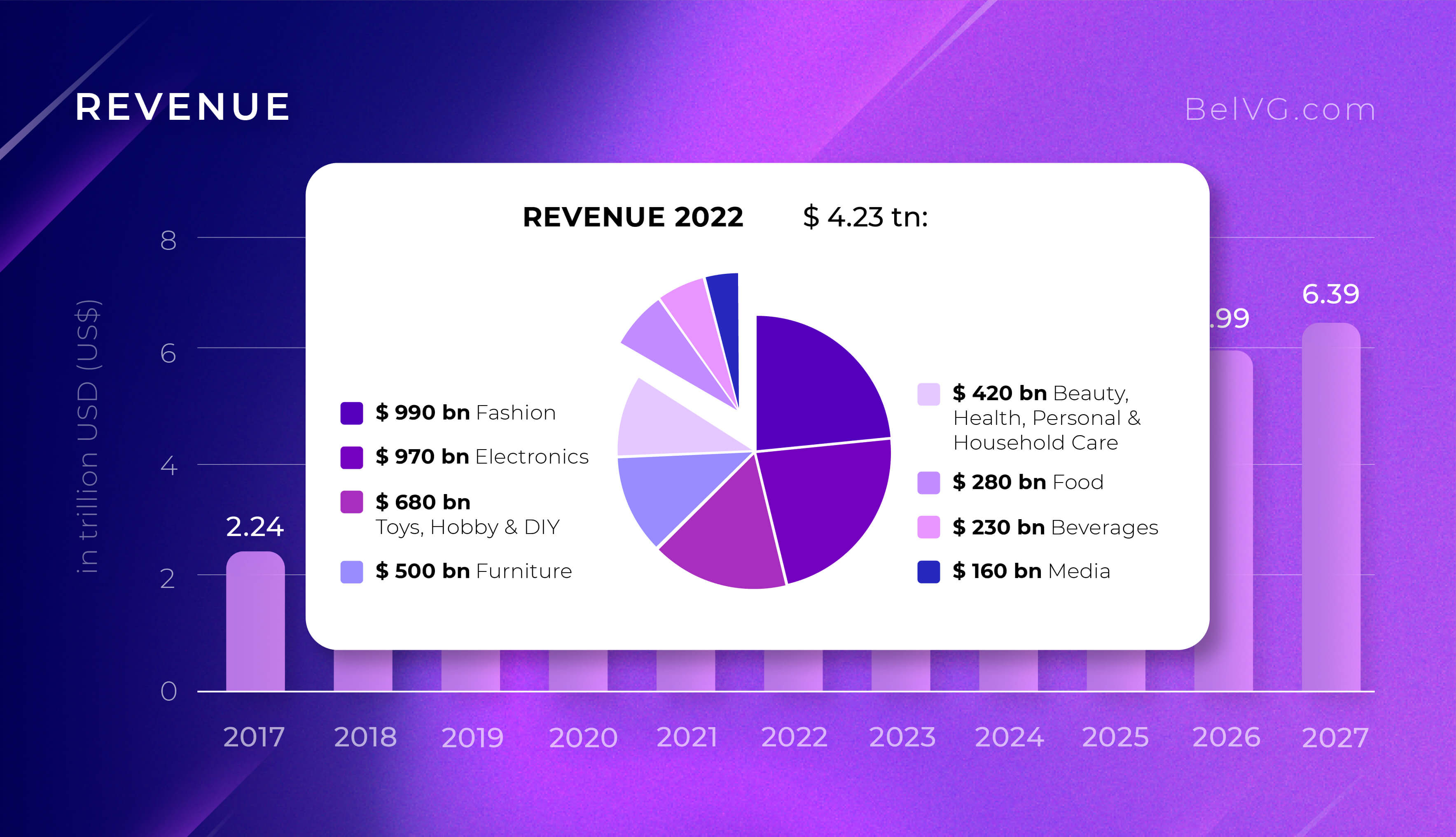
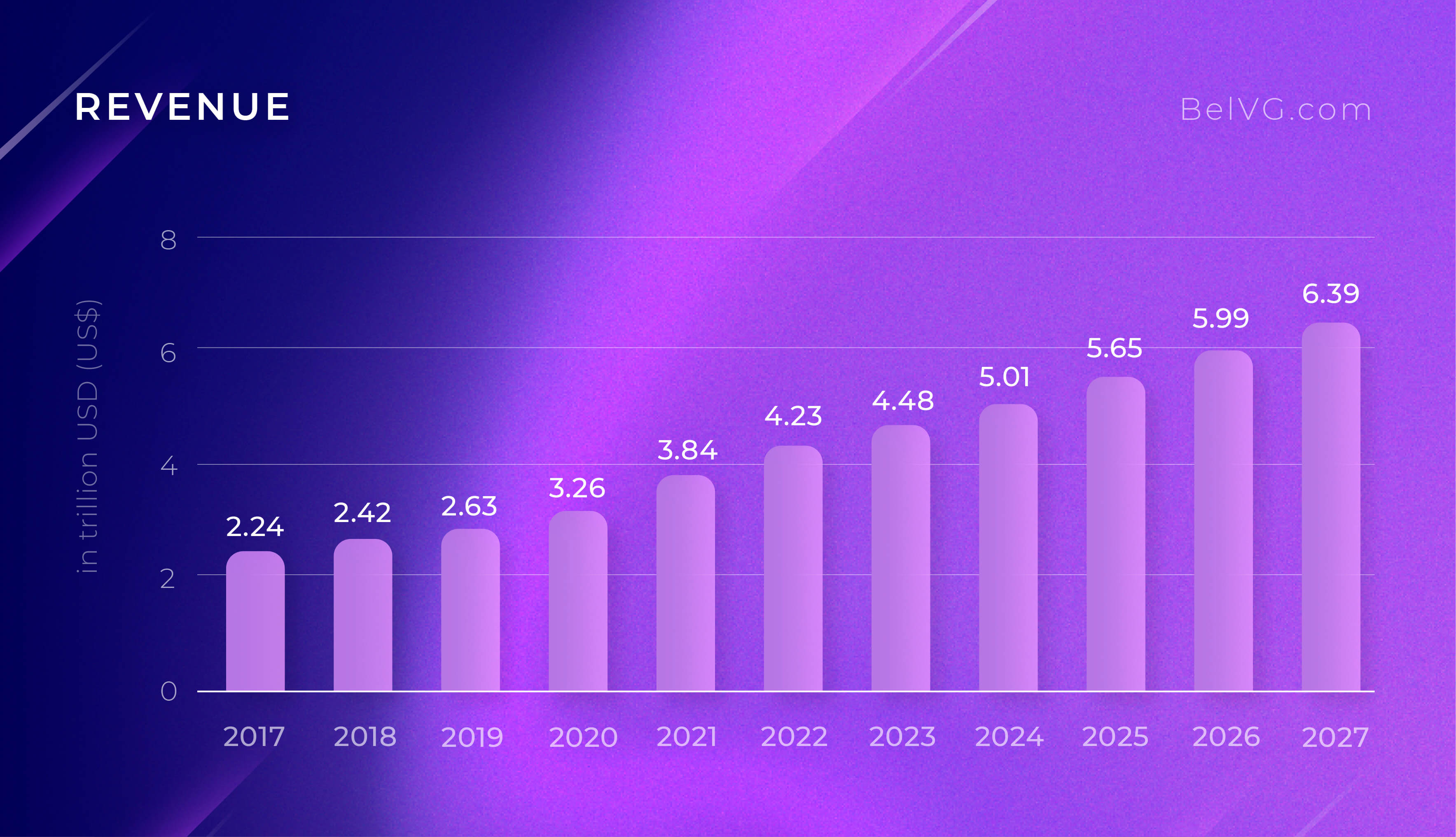
These capabilities surpass those available in traditional retail. With all the diversity and benefits, it is no surprise that over the last few years, the ecommerce business has globally enjoyed steady and substantial growth. This tendency isn’t going to change – ecommerce is expected to keep growing, reaching $5.88 trillion in global sales by the end of 2025, according to Statista [2].
Ecommerce keeps taking up the share of traditional retail. Throughout history, some companies have crashed due to their inability to confront online businesses, while others have made a success story. Below, you can find out how ecommerce has changed the global market.
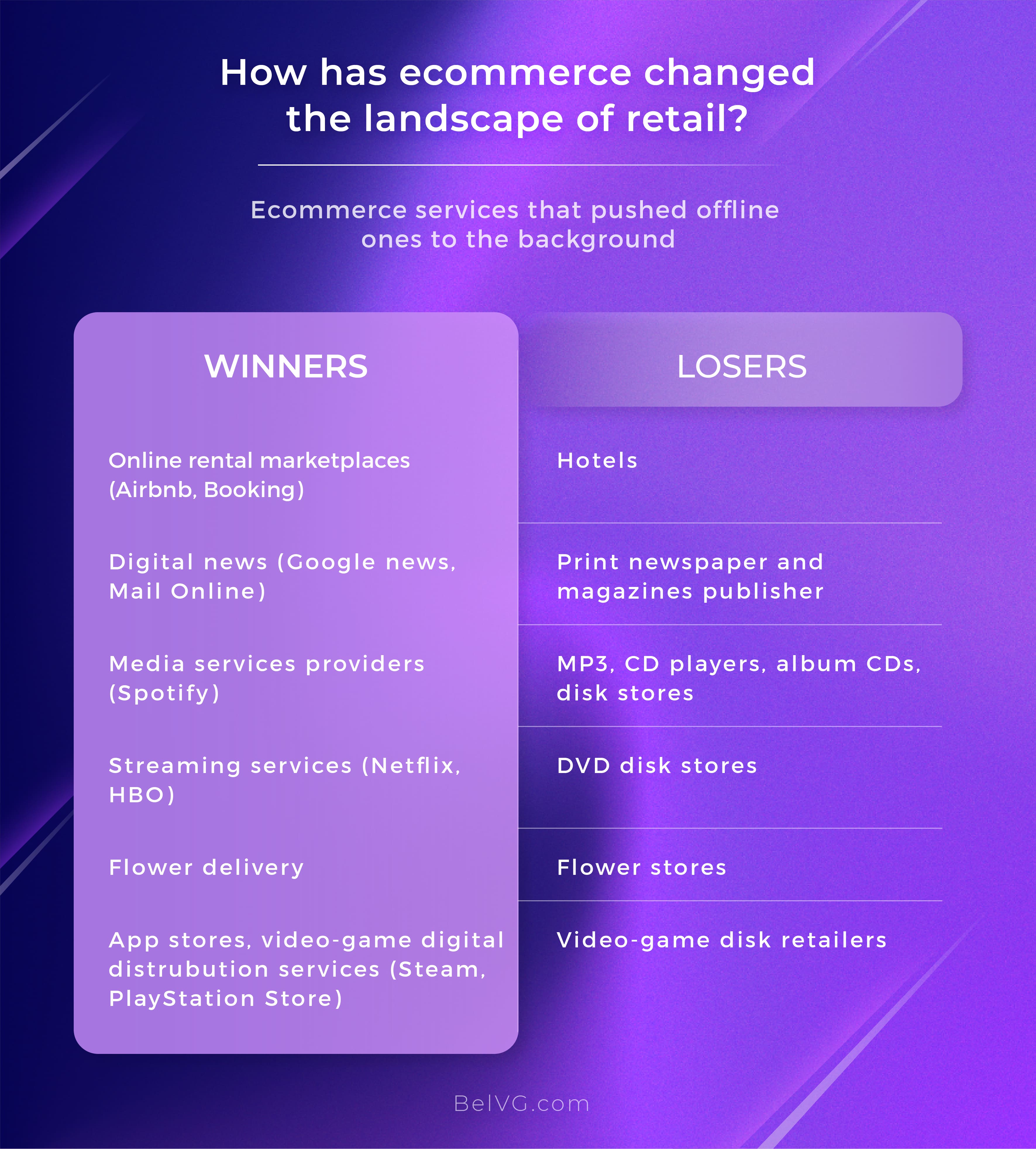
A good example of ecommerce influence on trading is the app development industry. About 20 years ago, stores had various disks keeping games, applications, and movies. But the digital breakthrough made it possible to provide them online. Such well-known platforms as Steam, Google Play Store, and Netflix were established. And that’s how ecommerce made disks almost useless.
The same situation takes place with newspapers and magazines. Two decades ago, almost everyone read printed materials to discover what was happening around them. But today, you can hardly find a newsstand. Smartphones made the latest news available in a second. The top magazines and newspapers like Forbes and the New York Times run their websites, making money on subscriptions. It happens not only because of the ecommerce influence but also because of the reforestation motives. A great benefit of ecommerce for the planet.
All this might be enough for you as an entrepreneur to consider starting an online store. Although the ecommerce pluses are evident, getting into the undiscovered activity is still unwise. That’s why we’ve done some research and are ready to familiarize you with both the advantages and disadvantages of an ecommerce company.

Ecommerce Development
Take your online store to the next level with BelVG ecommerce development
Visit the pageHow Ecommerce Works
Ecommerce Process
The ecommerce process includes key steps that enable businesses to sell products and services online efficiently. It starts when potential customers visit an online store to browse offerings. Once they find what they want, they add items to their online shopping cart.
Customers then go to the checkout page to enter their payment and shipping information. This step is essential for secure transactions and accurate delivery of online purchases. The ecommerce platform processes the payment using secure gateways to protect customer data.
After confirming payment, the business ships the order to the customer. Businesses can enhance the shopping experience by recommending products based on past purchases or browsing history, which fosters customer loyalty.
Ecommerce offers benefits like reduced overhead costs and global reach, allowing businesses to effectively compete with traditional retail and expand their market presence.
Types of Ecommerce
Ecommerce Business Models
Electronic commerce businesses operate under various business models, each serving different transactions and customer relationships:
- Business-to-Business (B2B): Businesses sell products or services to other businesses, often involving larger transactions and longer sales cycles.
- Business-to-Consumer (B2C): Businesses sell directly to individual customers, commonly seen with online retailers and subscription services, and digital marketplaces, focusing on a smooth shopping experience.
- Consumer-to-Consumer (C2C): Individuals buy and sell directly to each other on platforms like eBay and Craigslist, which provide a secure environment for transactions.
- Consumer-to-Business (C2B): Individuals sell products or services to businesses, such as freelancers offering skills or influencers promoting brands for compensation.
Ecommerce businesses can also utilize online marketplaces and social media platforms to reach a wider audience. Understanding these models and effective marketing strategies can help companies attract more customers online.
What Are the Advantages of Ecommerce?
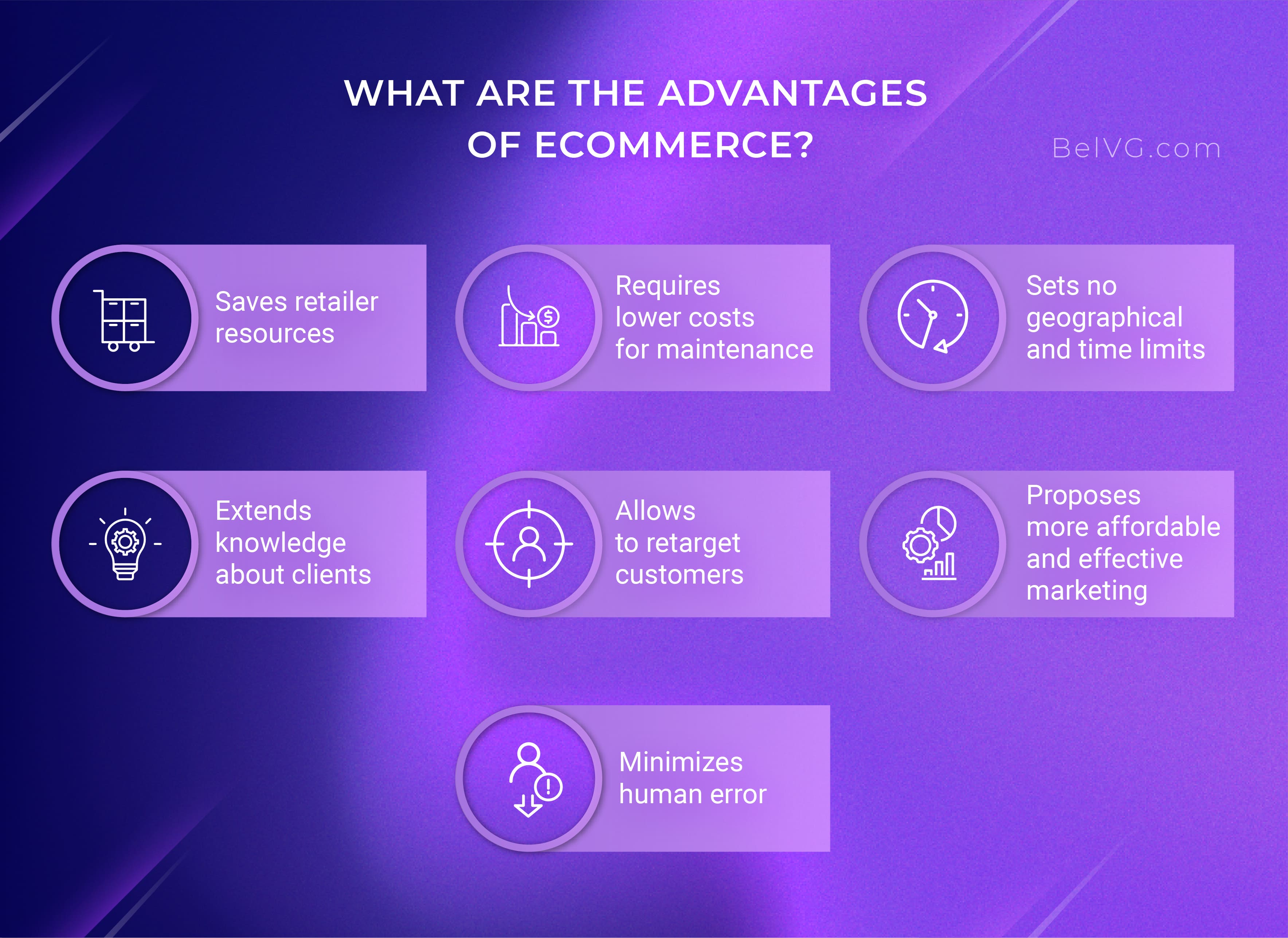
The advantages of ecommerce can be divided into two huge groups: for those who are shopping online and others who are selling online. In this article, we’ll study the latter. But it’s important to at least know the pros that online shopping gives to customers. They include
- mobility, as you can buy from anywhere
- delivery system
- no queues
- full product description
- buyer reviews.
The advantages for retailers are listed and reviewed below.
Advantage No 1: Saves business resources
Most customers want to know as much as possible about the product before making a purchase. However, brand manufacturers have text limits on packaging. This is why in a brick-and-mortar store, the sales assistant must to knowledgeable about additional product information to share with customers. Consequently, the owner invests resources to hire sufficient staff and train them.
At the webstore, a retailer can add a product information page with macrophotos, tutorials, buyer reviews, and a list of related products. All this information not only makes a great contribution to a more conscious “to buy or not to buy” decision, but also minimizes staff functions. So, the owner needs just a few people who help clients online, as customers can easily find all the information they need for online purchases with just a few clicks.
Advantage No 2: Requires lower costs for maintenance
Running a physical store is an expensive activity: rent of the facility, utility bills, insurance, warehouse maintenance, and staff salary. Owners should also keep in mind many operational costs, like repair service bills, employee training, and advertising costs. With an ecommerce store, you pay only to build up a webstore and then to maintain it, including payments for a warehouse.
Advantage No 3: Sets no geographical and time limits
The location of a brick-and-mortar store significantly restricts trade opportunities and limits the reach to potential customers. While doing business online, you have no geographical limits. You can extend your market without renting an extra office somewhere. And thanks to improved logistics and delivery technologies, worldwide shipping will be an achievable goal. Payment, in its turn, can be performed even if your credit card isn’t with you and you only have your mobile devices at the moment, thanks to Apple Pay, PayPal, and others.
Shopping online also has no time limits. It’s open 24/7 and accepts orders around the clock, while a physical store works only 8-10 hours per day.
Advantage No 4: Extends knowledge about clients
Running a brick-and-mortar store, it’s difficult to know who your online customers are. Where do they work? What are their hobbies? Did they find everything they looked for? Would they buy any related products in your store? A shop owner must conduct time-consuming research to gain that knowledge.
Cookies can help you collect customer information and get a clear understanding of who they are: gender, age, interests, kinds of advertisements they better respond to, etc. Using this data, you can configure the store to automatically offer customers the products they are most likely to like and set up an advertisement with a good click-through rate.
Advantage No 5: Allows for retargeting customers
It often happens at brick-and-mortar stores that even customers interested in the item leave a physical store without a purchase. It happens because many people need time to consider it, especially if the price is high. And lots of them forget about a planned purchase by the end of the day. Unfortunately, there is no chance to remind them. Running a webstore, you have that chance.
Retargeting is an advertising technology that shows your customers ads for the product they viewed at the online store before. It helps to unobtrusively remind customers of the product they liked, urging them to return to the store and make a purchase.

Magento Web design
Take your online store to the next level with BelVG Magento web design services
Learn moreAdvantage No 6: Proposes more affordable and effective marketing
Promoting a physical store, you use traditional marketing practices such as printed press, radio, TV commercials, direct mail, and telephone. Such strategies offer little interaction with the audience and yield a poor conversion ratio. An online promotion requires at least a website and a robust social media strategy.
Ecommerce works with digital marketing that provides a broader scope of operation and a bigger number of activities, including content marketing, SEO, affiliate marketing, email marketing, pay-per-click, and social media marketing. Unlike the radio or TV, these tools allow for the narrowing of the audience. A shop marketer can specify potential clients by age, gender, city of residence, hobbies, and Google request, and as a result, broadcast the advertisement only to the needed audience.
Advantage No 7: Minimizes human error
Most store operations are integrated into an ecommerce platform and perform automatically. It diminishes the probability of such mistakes as a misplaced order or an incorrectly charged bill. Moreover, the situation where a sales manager follows and annoys a customer is impossible. However, not to leave the potential buyers alone, a business owner can create an FAQ page and use virtual assistance.
What Are the Disadvantages of Ecommerce?
Apart from numerous advantages, some disadvantages make ecommerce unsuitable for some businesses. Let’s explore them in detail and determine if they are significant enough to stop you from launching a webstore.
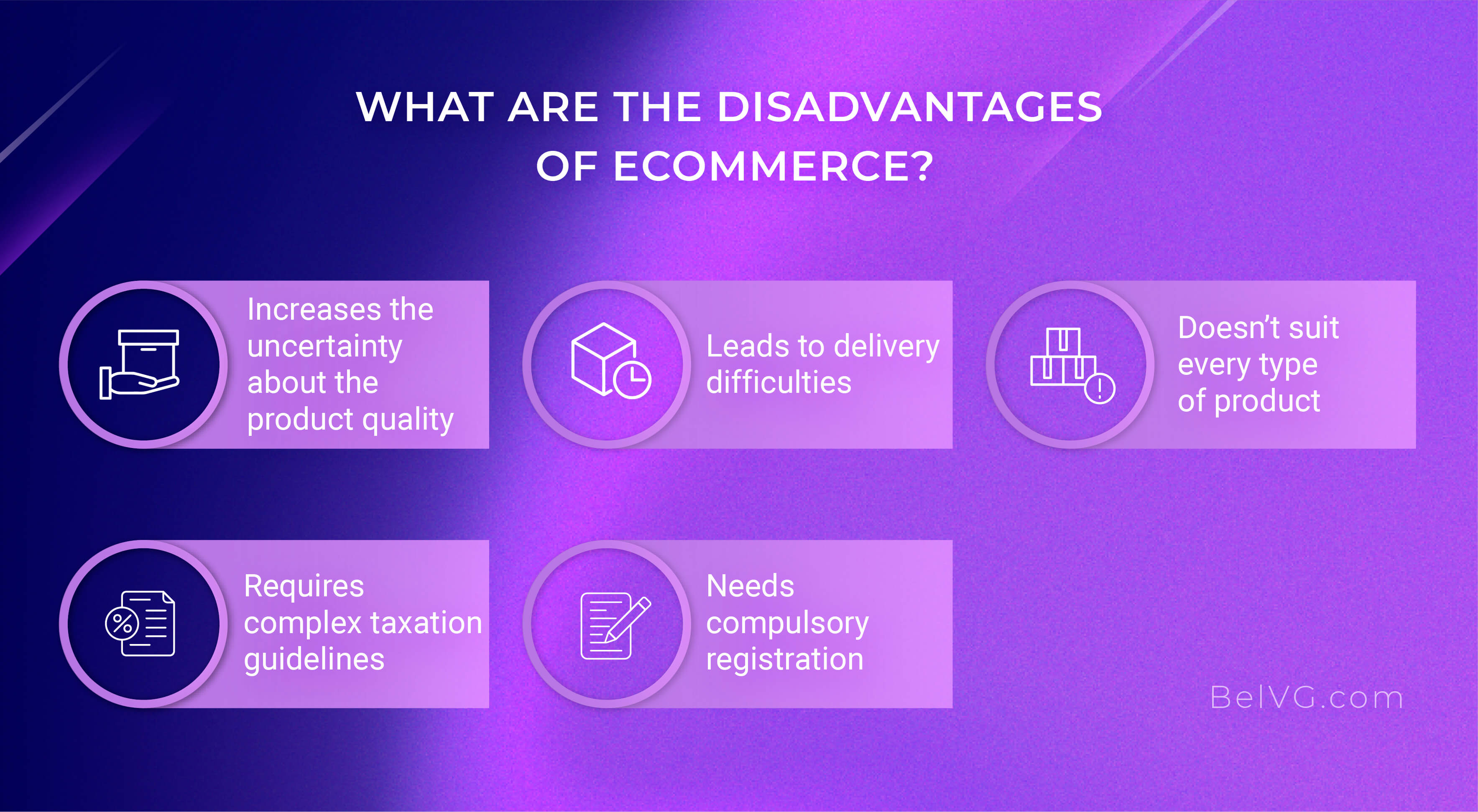
Disadvantage No 1: Increases the uncertainty about the product quality
An online store provides a detailed product description but doesn’t allow customers to see or feel the item before purchasing. As a result, they can’t make sure whether the description is true or not. Here, the main role in customer decision-making is the store’s reputation and positive reviews. The business owner has to closely monitor the quality of the products being sold to keep customer loyalty.
Disadvantage No 2: Leads to delivery difficulties
Shipping often becomes a headache for store owners. Once you decide to run an ecommerce business, you need to devise the delivery logistics, find the carriers, ensure that the products will be shipped correctly and on time, and deal with all sorts of delays and complications. In the worst scenario, the purchase might never be delivered, either lost in the mail or sent to the wrong address.
However, in the last few years, a tendency has appeared to minimize these worries. Delivery companies use tracking codes so that both the sender and the receiver can control the shipping process. The pandemic also played a part in adjusting the delivery system. And how this disadvantage seems to lose significance.
Still, if you’re launching an online store, consider organizing a delivery with a specialized company instead of trying it yourself.
Disadvantage No 3: Doesn’t suit every type of product
There are certain limits to ecommerce capabilities, such as products that are difficult to select correctly or suit perfectly. Among them are high-priced items such as custom-made items, luxury clothes, and furniture. The most progressive shop owners successfully implement Augmented Reality technologies in their webstores, but this is still a very rare practice.
Another type of product that is unpopular in online retail is the one that requires a related service to accompany its purchase, like a roof luggage rack for a car that needs installation.
Disadvantage No 4: Requires complex taxation guidelines
If you sell your products worldwide, you need to comply with the taxation guidelines of each country you’re delivering to. Apart from making sure you can comply with them, you’ll need to deal with the question of cost-effectiveness for your enterprise.
Disadvantage No 5: Needs compulsory registration
Usually, a customer must register on the website to complete an order. The problem is that many people don’t want to sign up. Due to the increased frequency of hacker attacks, it’s understandable why some customers are reluctant to submit their name, email address, and other personal data to an online store. Also, some make purchases quickly and don’t want to spend time on a rather lengthy registration process.
Wrapping It Up
We’ve studied the detailed list of the ecommerce advantages and disadvantages.
This type of store has several advantages over an offline business. It requires lower costs and resources to maintain, allows selling worldwide without being bound to a particular location, and offers rich marketing instruments to interact with, target, and stay in touch with the audience.
At the same time, several disadvantages are mostly connected with customer uncertainty about quality, delivery methods, and security of personal and payment data. But the tendency shows that they are becoming more insignificant while ecommerce develops.
We hope you find this article helpful! If you have anything to share about ecommerce, feel free to leave your ideas in the comments below!

Partner With Us
Looking for a partner to grow your business? We are the right company to bring your webstore to success.
Talk to Tatiana
It’s a great post. This blog is so interesting to me.
provides a complete information about pros and cons of e-commerce is very useful.
I appreciate you sharing this.
Thanks for your post. It’s clear!
Thank you for sharing this fantastic blog. It provided me with a wealth of information, as well as an understanding of the benefits and drawbacks of ecommerce.
Thanks for sharing this information.
Thanks for sharing your thoughts about e-commerce. Very Helpful. You really did a lot of research.